Your AI Is Flying Blind: How MCP Finally Gives It Eyes

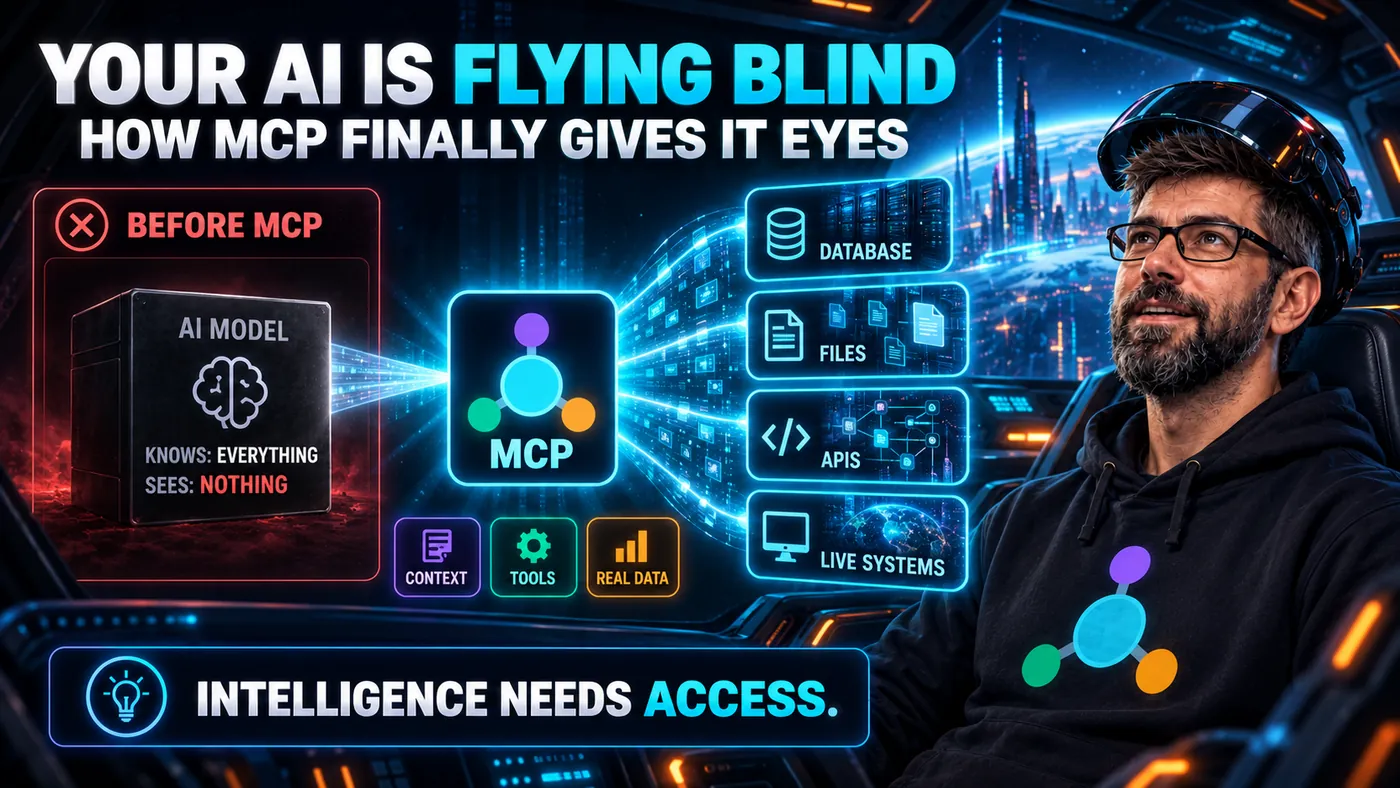
Your AI knows things. An extraordinary amount of things. It can explain the Krebs cycle, debug a segfault, and write a sonnet about dependency injection. And yet, it cannot tell you what's currently in your calendar.
This isn't a capability gap. It's an architecture problem. And MCP exists to solve it.
The Brilliant Prisoner Problem
Imagine the world's most knowledgeable professor. She's read every book, every research paper, every technical document ever written. Her recall is perfect. Her reasoning is exceptional. She can synthesise ideas across disciplines in seconds.
Now lock her in a room.
She gets messages slipped under the door. She writes responses and slips them back. The advice is brilliant. The analysis is excellent. But ask her to check something on your company's internal dashboard, and she stares at the ceiling. She doesn't have internet access. She doesn't have access to your systems. She doesn't have access to anything that happened after the last time someone updated her training data.
Her whole world looks like this:
The two boxes never touch, and that gap is the entire problem. Everything she knows is on the right, sealed in with her. Everything you actually want to ask about is on the left, and there is no line between them.
That's a large language model. GPT-4, Claude, Gemini, it doesn't matter which one. They all share this fundamental limitation: they know a staggering amount about the world as it was when they were trained, but the real world is a live, dynamic system they cannot directly observe.
The Brute-Force Solutions
Developers are creative people. We don't wait for elegant solutions when we need something to work today. So before MCP, we built work-arounds:
Prompt stuffing. Copy the relevant data, paste it into the prompt. Need the AI to analyse your latest sales figures? Paste the CSV. Need it to review a database record? Copy the row. This works until the data is too large, too dynamic, or too sensitive to paste.
Custom tool calls. OpenAI's function-calling feature (2023) let you define functions the model could invoke. The model would produce a function call; your code would execute it; you'd feed the result back. Strip off the API-specific wrapping and that call was a name and some arguments:
{"name": "get_orders", "arguments": {"customer_id": 42}}
Brilliant. Except: every application reinvented this from scratch, for every model, every tool, every use case. No standard existed. The integration you built for GPT-4 didn't work with Claude. The tool you wrote for your chatbot didn't work in your code assistant.
RAG without standards. Retrieval-Augmented Generation let models fetch relevant documents at query time from a vector database, a store that finds text by meaning instead of by keyword. Excellent for static knowledge. Not great for "what's currently in the order queue" or "what does this API endpoint return right now."
None of these are wrong. They're all useful. But they're all reinventing the wheel.
MCP: A Standard for the Integration Layer
In November 2024, Anthropic open-sourced the Model Context Protocol, a specification for how AI applications should connect to external tools and data sources.
The elegant insight behind MCP is that the integration layer was the problem, not the tools themselves. Everyone was building database connectors, filesystem tools, and API bridges. The tools worked. But each AI application had to invent how it talked to them.
Every client wired itself to every tool by hand:
Nine connections, each maintained separately. MCP replaces the mesh with one contract each side implements once:
Six connections, and a fourth client adds one instead of three. MCP standardises three things:
- Define a Tool once: the model can call it to take actions
- Define a Resource once: the application can read it and hand it to the model as context
- Define a Prompt once: users can invoke structured workflows
The service that offers them is an MCP server: your own code, running where your data is, speaking the protocol. The client side has primitives of its own, covered in MCP Has Six Primitives, Not Three.
Build your database MCP server once. It works with Claude Desktop. It works with Cursor. It works with GitHub Copilot. It works with your custom agent. Stop writing the same integration four times.
What "Flying Blind" Actually Means
Here's a concrete example of what changes.
Before MCP: You're debugging a production issue. You paste the last 50 lines of the log into Claude. You paste the relevant code. You describe what you think the problem might be. You wait. Claude gives you a plausible but potentially wrong answer because it's working from a snapshot you curated, not from the live system.
With MCP: Your AI assistant has a filesystem MCP server and a database MCP server connected. You say "why is the payment service erroring?" The assistant reads the live logs directly (via a Resource). It queries the relevant database tables to check transaction state (via a Tool). It examines the actual service code (via the filesystem Resource). It gives you an answer grounded in what's actually happening, not what you remembered to paste.
That exchange, in the order it happens:
The three fetches in the middle used to be your copying and pasting.
The AI isn't flying blind anymore. It can see.
Why It's Different This Time
"AI + tools" sounds like a solved problem. We had plugins. We had function calling. We had RAG. What makes MCP different?
Standards. USB-A worked. USB-B worked. MicroUSB worked. But nobody was happy about carrying four cables. USB-C isn't a new technology; it's a standard that ended the fragmentation. MCP isn't new technology; it's the standard the AI tool ecosystem has needed.
Adoption velocity. The sign that a standard is working isn't the spec document, it's adoption. Within months of publication MCP was integrated into Cursor, GitHub Copilot, Zed, and dozens of other tools. The moment that mattered most came four months in, when OpenAI adopted it across the Agents SDK, the Responses API and the ChatGPT desktop app. A protocol its author's closest competitor implements is a standard. One that only its author implements is a file format.
MCP's first year, in dates:
By December 2025 the community had published more than 10,000 MCP servers, and that figure keeps moving. The Agentic AI Foundation (AAIF) MCP joined that month is a directed fund under the Linux Foundation: member companies pay into one family of projects with its own governing board. Two other projects joined as founders alongside it, and both are worth knowing by name.
- goose, contributed by Block, is an open source AI agent you run on your own machine, as a desktop app or a command-line tool. It is one of the larger MCP clients in the wild: connecting an MCP server to it is how a lot of people first see one working outside a vendor's chat window.
- AGENTS.md, contributed by OpenAI, is a file format, with nothing to install and nothing to run. It is a single markdown file you commit at the root of a repository, holding the things a coding agent needs and a human README usually leaves out: how to build the project, how to run its tests, which conventions to follow. The site reports more than 60,000 repositories using it.
The three together say what the foundation is for. MCP is how an agent reaches your systems, goose is an agent you can run, and AGENTS.md is how a repository explains itself to one.
Vendor-neutral governance was the official seal on what adoption had already proved. When a standard solves a real problem, adoption is fast.
Open ecosystem. MCP is not Anthropic-proprietary. The spec is open. Any model, any client, any server can implement it. That's the difference between a standard and a vendor feature.
Where to Go From Here
If this sparked something, you're in the right place. TheMCPGuy is built to be the definitive learning resource for MCP, from theory to production Java implementation.
Start with MCP Fundamentals, eight modules covering everything from the architecture to the security model, without writing a single line of code. Understand the protocol before you implement it.
Then, when you're ready to build, the Java SDK course takes you from zero to a production-grade MCP server in Java.
Your AI has been flying blind long enough.
Further Reading
- Introducing the Model Context Protocol: the original announcement from 25 November 2024, with the problem statement and the first adopters.
- Architecture overview: how host, client and server fit together, which is the integration layer this post argues about.
- Understanding MCP servers: tools, resources and prompts, with a table of who controls each one.
- Understanding MCP clients: the other half of the protocol, sampling, elicitation and roots.
- MCP specification 2026-07-28: Tools: the normative rules for
tools/listandtools/callin the current revision. - MCP specification 2026-07-28: Resources: how a server exposes read-only context by URI, the mechanism behind the live-log example.
- MCP specification 2026-07-28: Prompts: the user-invoked templates that make up the third primitive.
- Writing effective tools for agents: Anthropic engineering on designing the tools an MCP server exposes, once you have one to build.
- Use MCP servers in VS Code: what connecting an MCP server to GitHub Copilot actually looks like if you want to try it today.
Sources
- Introducing the Model Context Protocol: the November 2024 open-sourcing of MCP by Anthropic, and Zed as one of the first adopters.
- OpenAI adopts rival Anthropic's standard: the March 2025 announcement, and why a competitor implementing it is the moment a format becomes a standard.
- MCP joins the Agentic AI Foundation: MCP as a founding project of the AAIF in December 2025, alongside
goosefrom Block andAGENTS.mdfrom OpenAI. - goose: the local-first agent, its desktop and CLI builds, and the MCP extensions it ships with.
- AGENTS.md: the file format, what belongs in one, and the tools that read it.
- Linux Foundation announces the formation of the Agentic AI Foundation: the 9 December 2025 date, the "more than 10,000 published MCP servers" figure, and the client list that includes Cursor and Microsoft Copilot.
- Visual Studio Code 1.99 release notes: MCP server support in Copilot agent mode, a few months after publication.
- OpenAI API deprecations: the 2023 date for function calling, announced on 13 June 2023.
- Understanding MCP servers: the three primitives and who decides to use each one, with tools called by the model and resources read by the application.
- Governance and Stewardship: MCP as an LF Projects series with Apache 2.0 contributions and individual maintainers, which is what "open" means here.