2 posts tagged with "tools"

View All Tags

Your Agent Is Drowning in Tool Definitions (Code Execution Throws It a Rope)

· 12 min read
TheMCPGuy
MCP Developer & Educator

Series cover. A figure is submerged in drifting tool-definition JSON, with counters reading twelve servers and forty tool definitions consumed before the user types. A beam labelled code execution offers discover, load, run. The strapline reads: discover first, load only what you need.

Here is a cost nobody warns you about when you wire up your fifth MCP server: your agent gets dumber and more expensive at the same time, and it happens before the user has typed a single word.

The reason is boring and brutal. Every tool your servers expose ships a definition: a name, a description, a JSON schema for its inputs, often examples. All of it gets serialized into the model's context window on every single turn, just so the model might pick the right tool. Connect a few busy servers and you are spending six figures of tokens describing tools the model will ignore for this particular request.
The Three Laws of MCP (Asimov Can Rest Easy)

· 17 min read
TheMCPGuy
MCP Developer & Educator

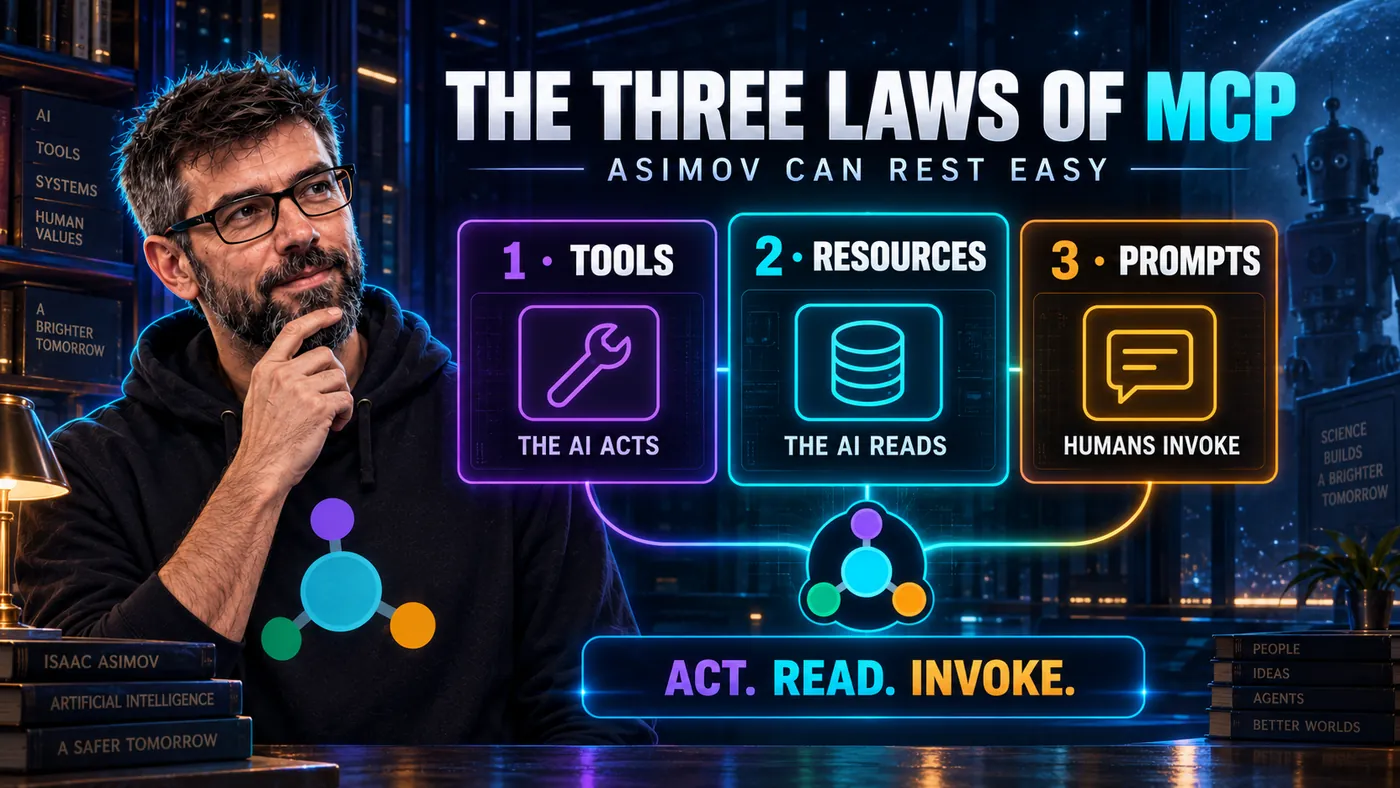
Series cover. Three numbered panels: Tools, where the AI acts; Resources, where the AI reads; Prompts, which humans invoke. The strapline reads: act, read, invoke.

Asimov's Three Laws of Robotics encoded a philosophy about how robots should relate to humans. They weren't just rules, they were a framework for reasoning about harm, autonomy, and control. The laws conflicted with each other by design, forcing a hierarchy.

MCP's three primitives, Tools, Resources, and Prompts, encode a similar philosophy. They're not just API categories. They're a framework for reasoning about how AI should interact with the world: what it can change, what it can only read, and what humans explicitly invoke.

Get them right, and your MCP server is intuitive, safe, and composable. Get them wrong, and you'll wonder why the AI keeps calling the wrong thing at the wrong time.